

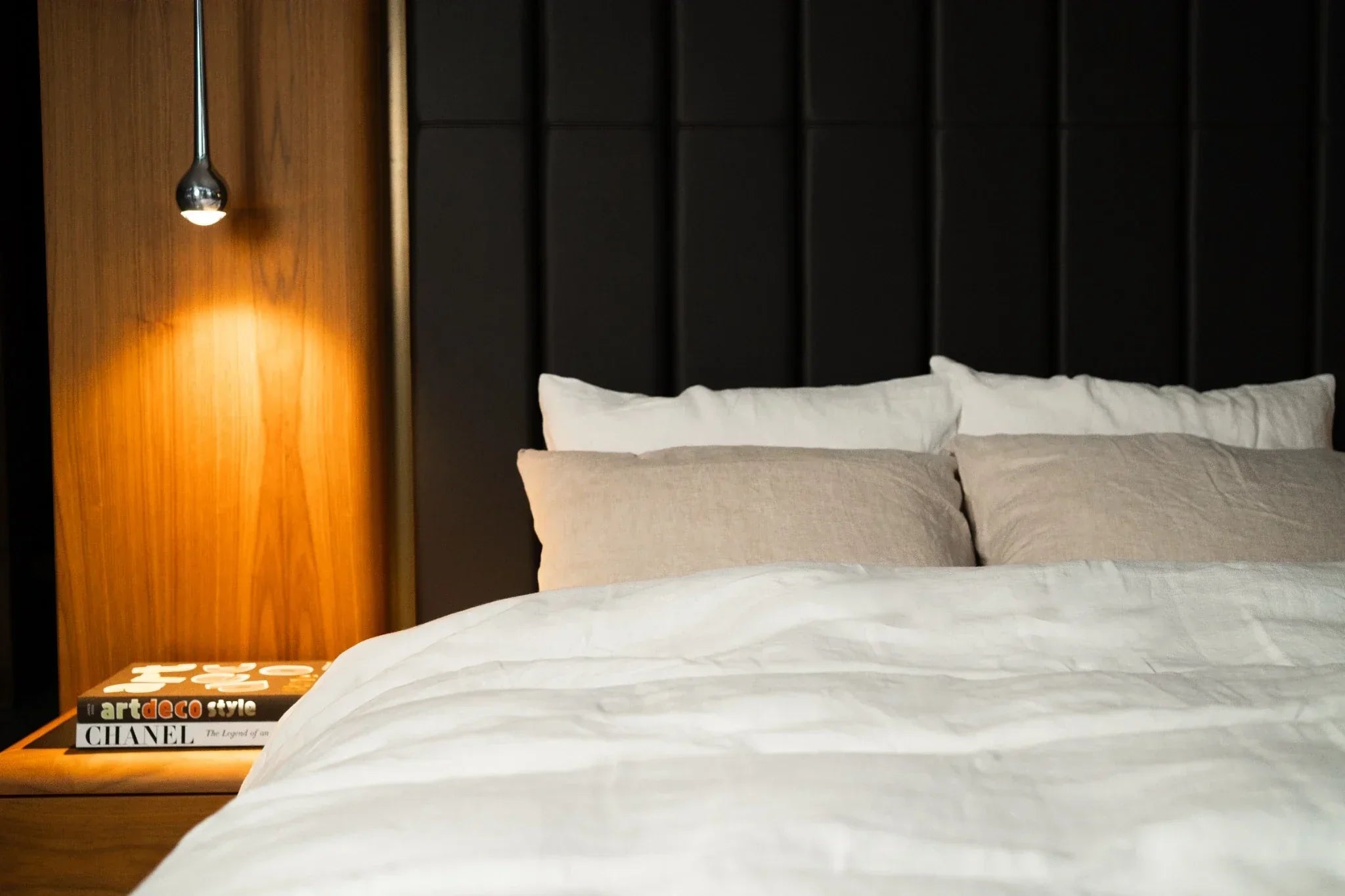
Cotton sheets are one of those things almost nobody questions. They're in every hotel, every home goods store, every wedding registry. Cotton is natural, cotton is breathable, cotton is fine — right? For most sleepers, maybe. But for the roughly 30% of people who sleep warm, cotton isn't just inadequate. It's actively making sleep worse.
The comparison between cotton and linen isn't about thread count or price point. It's about physics — specifically, about what happens to your body heat and moisture over the course of a night. Once you understand the mechanism, the difference becomes impossible to ignore.
How Cotton Handles Heat (And Why It's a Problem)
Cotton's reputation as a breathable fabric is accurate — in the right context. Compared to polyester or microfiber, cotton genuinely does allow more airflow. But "breathable" is relative, and for hot sleepers, cotton has a fundamental structural limitation.
Cotton fibers are dense and absorbent. When heat from your body contacts cotton fabric, the fibers rapidly absorb that heat — you feel a brief moment of coolness against your skin. But within seconds, those fibers are saturated. Once saturated, cotton stops releasing heat to the surrounding air and begins reflecting it back toward your body. The result is a layer of trapped warmth sitting directly against your skin.
This happens within the first 15–20 seconds of contact. For most of the night — 6, 7, 8 hours — your cotton sheets and duvet cover are functioning as a heat trap rather than a heat exchanger.
"Cotton feels cool for the first few seconds. After that, it's holding your heat against you — for the rest of the night." |
How Linen Handles Heat Differently
Linen is made from flax, a plant with a fundamentally different fiber structure than cotton. Flax fibers are hollow and open-structured, which means they don't absorb heat the way cotton does — they exchange it. Air moves through linen fabric continuously, carrying heat away from your body and releasing it into the room.
This is why linen doesn't give you that initial cool-touch feeling that cotton does. It doesn't absorb your heat in the first place. Instead, it maintains a near-constant, neutral temperature at the fabric surface throughout the night. Your body isn't fighting the fabric to cool down — it simply does, unimpeded.
Linen is approximately 3× more breathable than cotton by fiber structure. That difference is measurable in sleep quality.
Side by Side: What Actually Matters for Sleep
| Cotton | Linen | |
|---|---|---|
| Heat handling | Absorbs then traps | Exchanges continuously |
| Breathability | Moderate | 3× higher |
| Moisture wicking | Holds moisture in fibers | Draws moisture away from skin |
| Night sweats | Creates damp, clammy feeling | Dries quickly, stays comfortable |
| Over time | Thins, pills, weakens | Gets softer with every wash |
| Lifespan | 3–5 years | 15–20 years |
| Temperature feel | Cool initially, then warm | Consistently neutral |
The Moisture Problem Nobody Talks About
Heat is the obvious issue, but moisture is equally disruptive — and less discussed. Most people who sleep warm experience mild night sweats, even when they don't consciously notice them. Small amounts of perspiration accumulate in the fabric throughout the night.
Cotton absorbs moisture into its fibers and holds it there. This creates a damp microclimate against your skin — slightly humid, slightly warm, slightly uncomfortable. Your body detects this and responds: lighter sleep, more frequent micro-wakings, restlessness that you don't fully register but that prevents you from reaching the deep sleep stages that actually restore you.
Linen's hollow fibers wick moisture away from the skin surface and release it into the air. The fabric stays drier throughout the night. For hot sleepers, this alone makes a significant difference to sleep continuity.
| Hours 0–1: Cotton absorbs body heat, feels comfortable |
| Hours 1–3: Moisture begins accumulating as cotton fibers saturate |
| Hours 3–5: Trapped heat creates a warm, humid microclimate |
| Hours 5–8: Disrupted sleep cycles, frequent micro-wakings, reduced deep sleep |
| Morning: You wake up tired despite 8 hours in bed |
What About Thread Count?
Thread count is one of the most successfully marketed myths in the bedding industry. A higher thread count means more threads are woven per square inch — which sounds like a quality indicator, but in practice it often means the opposite for sleep.
Higher thread count fabrics are denser. Denser fabrics trap more heat. A 1000-thread-count cotton sheet feels silky and luxurious to the touch, but it's significantly worse for hot sleepers than a 200-count alternative — and both are worse than linen, which doesn't use thread count as a quality metric at all.
Linen quality is measured by grams per square meter (g/m²) — the weight of the fabric. For bedding, a weight around 155–165 g/m² represents the ideal balance: substantial enough to feel premium, light enough not to trap heat.
The "Scratchy Linen" Myth
The most common objection to linen bedding is texture. Most people have encountered linen that felt stiff or rough — either in a restaurant, a holiday rental, or a cheaply made set. That experience is real, but it's not inherent to linen. It's a result of how the linen was processed.
Raw linen is indeed coarse. But stonewashed linen — fabric that has been tumbled with stones or pumice during production — is soft from the first night. The stonewashing process physically breaks down the stiffness of the fibers before the fabric ever reaches you, so you get all the thermal properties of linen without any of the break-in period.
The softness also improves with every wash. Unlike cotton, which degrades over time, linen becomes noticeably softer after 10, 20, 50 washes. A well-made linen set gets better the longer you own it.
"Thread count is a marketing metric that has nothing to do with sleep quality. For hot sleepers, it may actually indicate the wrong direction." |

The Cost Argument, Done Properly
Linen costs more upfront. A quality linen duvet cover set runs $300–$400. A comparable cotton set might be $60–$120. The comparison seems obvious until you factor in lifespan.
Cotton bedding typically lasts 3–5 years before it starts thinning, pilling, and losing its structure. Linen, maintained properly, lasts 15–20 years. Over a 15-year period, you'd replace cotton sets 3–5 times — spending $180–$600 total. A single linen set covers the same period and comes out ahead, while getting softer every year.
That's before accounting for the sleep quality difference — which, if you're a hot sleeper, is the more significant variable. A $395 investment that genuinely improves your sleep every night is a different category of purchase than a $60 set that looks fine on the shelf but undermines your rest.
Who Should Actually Switch
Not everyone needs linen. If you sleep cool, cotton is perfectly adequate. But if you recognise any of these patterns, switching fabric type is worth considering before anything else:
| You regularly wake up between 2–4am feeling too warm |
| You flip the pillow looking for the cool side |
| You kick off the duvet and then pull it back within minutes |
| You wake up feeling unrested despite sleeping enough hours |
| You and your partner have mismatched temperature preferences |
| You turn the AC down at night but still sleep warm |
If two or more of those are familiar, the fabric of your bedding is likely contributing to the problem. Temperature regulation is the most overlooked variable in sleep quality — and it's also one of the most straightforward to fix.

